
Our Unique Perspective
Since 2004, IT Jobs Watch has published a unique, demand-side view of the UK digital and information technology employment landscape. The website is built on a commitment to open data and analysis. All published statistics and insights are released under a Creative Commons licence and recalculated on a daily basis.
Published material includes:
- Headline job market statistics and indicators
- Trends in skills, technologies and capabilities
- Job role trends
- Salary benchmarking
- Contractor rate benchmarking
- Skill set analysis
The data is available alongside an extensive digital and IT job board, giving a single platform for anyone exploring or finding work within the technology sector.
The website serves a broad audience that includes job seekers, industry professionals, recruitment agents, HR personnel, students, researchers, and journalists.
Open Research Notes
IT Jobs Watch also publishes an open research strand that complements the demand-side data work. Research Notes is concerned with patterns, weak signal analysis, framework and vocabulary development, and provisional commentary on the wider landscape of technological change. The data work reports what is measurable now. The research examines what is becoming visible.
The corpus to date includes work on AI-mediated coordination, protocol design, and vocabulary for emerging technological phenomena. The research is written for strategists, executives, managers, architects, academics, researchers, and journalists, and is published as living documents under a Creative Commons Attribution 4.0 licence. For a fuller account of the editorial position, methodology, and licensing, see the Aims and Scope page.
Getting Started
The homepage displays a job market index of permanent job roles, skills, technologies, and capabilities in a structured table format, with entries initially ranked by popularity. The job market index is updated daily and today covers the 6 month period to .
The index can be filtered using the search panel. For example, by:
- Selecting multiple skill and/or job role search terms
- Filtering by multiple choice category. For example, Programming Languages
- Selecting a job location such as London or Hybrid/Remote.
The market index can be sorted in ascending or descending order by clicking the column headings.
Each entry in the index links to in-depth analysis and historical trends dating back to 2004.
Rank: denotes the relative popularity of each entry based on the number of unique job vacancies observed over a 6 or 3-month period. A rank of 1 signifies the highest popularity. This rank is calculated at a national level, as well as for individual regions, areas, and cities.
Rank Change: measures the shift in popularity of an entry over the previous 6 or 3-month period compared to the same period in the previous year. This figure serves as a basic indicator of relative change in demand across the entire job market. A positive Rank Change signifies a relative increase in demand, whereas a negative value indicates a relative fall in demand.
Example Insights

|
Demand Trends
|


|
Salary Trends
|

|
Salary Histograms
|

|
Contractor Rate Trends
|

|
Contractor Daily Rates
|
Methodology
Since 2004, IT Jobs Watch has published free demand-side labour market insights including digital and information technology skill set trends, salary and contractor rate benchmarking and job vacancy statistics.
We research and publish actionable insights based on continuous and rigorous analysis of digital and IT job vacancy postings.
Contractor rates are calculated directly from the figures quoted. We do not derive average hourly rates from daily rates quoted or vice versa.
Salary Distributions
Our salary distributions, including the median, offer a guide and are calculated directly from the figures quoted in job vacancy postings. Benefits in kind, bonuses, etc., are not included in the calculations.
Average salaries (and average contractor rates) are based on the median or 50th percentile.
Most salary distributions tend to be positively skewed, with a larger number of lower salaries and a small number of high salaries. Very high or low salaries in respect to the rest of the market are referred to as outliers. Average salaries based on the arithmetic mean are adversely affected by these outliers. Outliers that are high tend to drive the mean upward. Similarly, very low outliers tend to drive the mean downward.
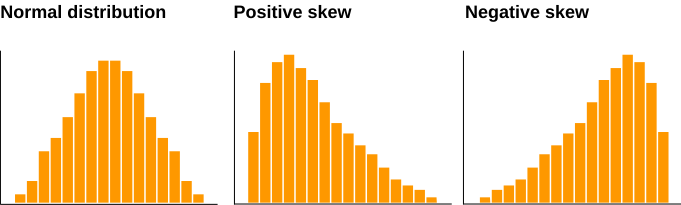
The median is not affected by outliers and as such provides a more representative market average for salaries.
To provide perspective on the distribution of salaries, we include two standard ranges around the median in the salary and contractor rate trend charts:
1. The 25th to 75th percentile range (or interquartile range) represents the middle 50% of salaries closest to the median. The interquartile range excludes the lowest 25% and highest 25% of salaries.
2. The 10th to 90th percentile range (or interdecile range) represents 80% of salaries closest to the median. The interdecile range excludes the lowest 10% and highest 10% of salaries.